Which Pool Cleaner?

All pool cleaners are not the same.  To get the best value for your money and low maintenance for your pool it is important you choose the correct pool cleaner.  For more information contact us, or visit our showroom, and we can help determine the best pool cleaner for your pool.


What is the difference between cleaners?

Suction cleaners work off the pressure of your pump, sucking the dirt and leaves through a 38mm hose into your skimmer box.  Due to the size of the hose, your skimmer and your pump basket they can only handle a certain amount of leaves.  If you have lots of leaves you will need to empty the skimmer basket on your pool very regularly (often daily).  A leaf strainer like the Baracuda Leaf Eater can help to stop your skimmer basket clogging and your pump running out of water.  Most suction cleaners are very reliable due to the small number of moving parts.  The Baracuda cleaners all have only one moving part, an easily replaceable diaphragm which pulses quietly to move your cleaner around the pool.

Pressure cleaners work by using the flow from your pump to blow or scoop the leaves into a big bag which can hold much more than your skimmer and if blocked will not stop your pool working.  These can be up to approx 120mm in diameter and can take much larger leaves and debris.  Some models require their own booster pump for adequate pressure which can be hard to retro-fit to old pools, but other models like the Polaris Vac-Sweep 165 or the Polaris 360 will run off your normal pool pump.

The Poolrite Manta, Zoltan, Algae-Eater, Kreepy-Krauly, Hayward Ultra or Questa Mini/Maxi Vac all operate similiar to the Zodiac Baracuda.  The Hayward and Questa cleaners operate differently to the other suction cleaners by using a programmed gear mechanism.  While this programmed method can work better in standard shaped pools they can be expensive to repair.  The Jetvac or Legend operate similiar to the Polaris pressure cleaners.

Which Pump and Filter?

The most important thing to ensure when selecting a new filter or pump is that they are both appropriately sized to each other. A larger filter requires less cleaning but can use more water to clean. It also requires a bigger pump. A smaller filter will clog up to often and not handle heavy loads or require long running times. You must also have an appropriately sized skimmer box and return jets to handle the water flow. For more information contact us, or visit our showroom, and we can help determine the best equipment for your pool.

What is the difference between pumps?

Most manufacturers produce a standard and heavy duty range of pumps.  The key differences to consider when selecting a pump are noise, energy efficiency, water flow and water pressure. Modern all-in-one plastic cased pumps provide the highest energy efficiency using water to continuously cool the motor and with the highest output for the lowest power input. Older pump and motor style pool pumps have the lowest energy efficiency. As pumps are often in wet areas those with stainless steel rotors (not mild steel) will not rust and as a result will last longer. These usually come with a 3 year warranty.  Lastly you must consider water flow. For solar systems, pressure cleaners and fountains high pressure pumps with lower water flow volumes are preferred however for you standard primary pool pump you want lower pressure and higher water flow. The main thing to consider here is that the pump is the appropriate size for your filter. Choosing a larger pump does not mean better filtering, in fact this just pushes the water through the filter too fast and reduces filtering quality.

What is the difference between filters?

Sand filters operate by filtering the water through a large bed of sand (that is why they are bigger). As the water is pushed through the sand by your pump the dirt is trapped in the sand. When you backwash the filter the water actually flows backwards through the tank and washes the dirt back out of the filter, but into the drain rather than your pool. The rinse cycle settles the sand down again and washes out any loose sediment. Opinions vary regarding how often sand should be changed, but how often do you change sand on a beach? Sand is a form of glass and as such cannot rot or decompose. Unless problems arise you will probably change your sand filter before you should need to change the sand (e.g. 15 years). It is important to remember with older filters that disassembling them to change the sand can cause more problems as parts can be easily broken and spare parts may not be available. Sand filters are not as efficient as other filters which is why we run them longer hours, but they are much lower maintenance.

Cartridge filters operate by catching dirt on the outside of a cartridge element which can be easily hosed clean. There are no valves or difficult plumbing. They are much finer than a sand filter but this means they can also clog faster. The advantage is that they can be cleaned easily and their finer filtering quality means they can operate for less time. If you have a lot of sediment in your pool or the pool gets green algae, clean your cartridge filter immediately, because it will clog with these fine particles. These filters can remove anything down to 10 microns which is much smaller than we can see.

WATER RESTRICTIONS – Cartridge filters use less water!!
Although they do require hosing to clean, a cartridge filter cleaned with a pressure hose will require only up to 15 litres of water to clean. A standard pool pump will pump up to 350 l/min. This means that a 2-4 minute backwash on a sand filter will require between 400 and 1400 litres.

Changing Sand in a Sand Filter

There are a number of varying opinions for and against changing sand in a sand filter.  There are a few important things to consider before changing sand:

  • How often is sand changed on a beach?  Sand is a form of glass.  It does not rot, it does not degrade but it may wear after millions of years of washing.
  • How old is your filter? Older filters, especially those which are sealed by a large number of bolts around the valves or connections, may be difficult to adequately seal after you have re-assembled them.  You may also have difficulty finding parts if you break any internals, like the laterals, when you change the sand.
  • Foreign media? It may be necessary to change the sand (maybe only partly) in situations where media like concrete dust, or dog hair has clogged the filter, due to activities around or in the pool. It can be an idea to remove the top and scoop off any lint accumulated on top of the sand and stir the sand up if your filter does not appear to be backwashing properly.
  • Will it filter finer? NO. A new sand filter does not filter very finely because the sand is clean.  Over the years the sand in your filter will settle, accumulate dust and lint and naturally filter finer. A new sand filter is very poor in it’s filtration quality.
  • Zeolite versus sand? The sand used in new filters contains granules from 1.18mm-6mm in size.  Zeolite has granules from 0.5mm-2mm in size which theoretically gives it finer filtration.  So that the filter operates at the same pressure we use less zeolite than we would sand in the filter.  The sand we use today is finer that what was used 10-15 years ago so there is not a significant difference and is still the most common filter media. Traditionally sand filters used -1 grade sand which has very large particles. Today Davey recommend 16/30 grade sand which is very fine.

In most cases, we do not recommend changing sand just because your filter is a few years old.  Those with older stainless steel filters should not change the sand, due to a lack of available parts for repair.  We are more likely to recommend replacing a filter before we will recommend replacing the sand.

Emptying a Pool

Emptying a pool is not to be done without prior consideration. A considerable amount of damage can be caused by leaving a pool empty. Inground pools are like a large bath tub in the ground. When we get heavy or continuous rain for a day or two the soil can become quite water logged. If it wasn’t for the weight of the water in your pool, the entire pool can float. It is not uncommon for a concrete pool to lift up to 1/2 a metre out of the ground as a result. To alleviate this your pool has a pit in the deep end. This usually covered pit contains a spring release valve designed to allow water from the soil into your pool if the outside pressure is higher than the inside pressure. If a pool is to be left empty the valve is often completely removed so water can flow from the soil in and out of the pool as necessary. Fibreglass pools are easily broken and even more easily damaged if left empty. In above ground pools it is the water pressure which holds the liner in position. If you empty the pool you will have to ensure the liner is flat and smooth again before and during filling and that the sand beneath the liner is still flat and level otherwise you may end up with creases, wrinkles or tears in the liner.

The reason that you see local council swimming pools empty is because they have a special drainage system and sump pumps that remove water from the ground below them to ensure no damage occurs.

Due to the associated risks many companies will not empty pools unless absolutely necessary. Apart from resurfacing or other major pool rectification work there is usually no need to empty a pool. Algae or staining are the result of incorrect water balance and can be often cleared by correcting the water chemistry.

D.E. Filters

Diatomaceous Earth (D.E.) filters are the best quality pool filter available. Used by Coca Cola in the production of soft drink they filter down to 5 microns. D.E. filters consist of a number of material elements inside a large filter. These elements are coated in Diatomaceous Earth and it is this combination that produces their excellent filtration quality. One problem with D.E. filters however is their cost. Ongoing maintenance requires a continual supply of diatomaceous earth and parts, such as the elements can be worth up to $100 each making them expensive to repair. They are also expensive to purchase initially and can cost up to twice that of a sand filter. In most cases a cartridge filter is a simpler replacement for an ageing D.E. filter.

Due to their cost, the level of maintenance required and the use of diatomaceous earth, which the water board is trying to stop being put down drains, they are slowly disappearing from the market. This is also making their cost increase. A larger cartridge filter or a sand filter and the occasional use of pool blue cubes or filter alum will require considerably lower maintenance and years of reliable operation.

As time constraints increase most people opt towards sand filters due to their minimal maintenance requirements. Most sand filters come with a 10 year tank warranty ensuring years of reliable operation.

Copper/Silver Ionisers

Copper and silver based ionisers purify water by creating free ions of silver and copper in the water. This method has been used for centuries and even today silver is used to purify water on passenger ships, airlines and oil rigs worldwide. Copper is the base of most algaecides and is good at preventing algal growth while silver is used in medicine for it’s antibacterial properties. By using these two ions together you can help keep water clear and clean. In conjunction with an ioniser a shock treatment of some kind is required to actually disinfect the water. This can include things like monopersulfate compounds or chlorine

Most people choose an ioniser because they do not want to use chlorine. Unfortunately you still have to use a sanitiser that is chlorine or similar as copper and silver alone will not constitute healthy water. The Nature 2 system is different to most ionisers in that it is a replaceable unpowered cartridge which releases ions in the water and is designed to be used in conjunction with chlorine to improve sanitation and help keep your pool clean, clear and healthy all year round.

For those who are looking for a chlorine alternative, it is important to note that there are not many chemical sanitisers as effective as chlorine, or as safe. No alternatives for chlorinated chemicals or products are carcinogen free. For more information read our help section regarding chlorine or contact us for what would be the best option in your situation.

* 2004 – NEWS – The Australian Pesticides and Veterinary Medicine Association (APVMA), the sanitiser regulation authority, has warned that copper and silver ionisers are not effective by themselves and must be used in conjunction with a registered sanitiser, essentially chlorine or bromine. This sanitiser must be maintained at the normal recommended levels.

Nature 2 was the first product to be affected by these changes and has modified it’s labelling on new products to suit. It was already designed to be used in conjunction with chlorine. Using a Nature 2 in conjunction with a salt chlorinator or liquid dosing pump can help your chlorinator cope with higher temperatures and high bather loads with relatively low maintenance.

The APVMA is now investigating other copper and silver ionisers available, as they are required to seek approval as a sanitiser. I will update this site as any further information becomes available.

New APVMA guide for demonstrating efficacy of pool and spa sanitisers – 28 July 04

New Guidelines
There is now a new set of guidelines for the approval of new pool and spa sanitisers. They must be an effective sanitiser against a list of recommended organisms and pass specified laboratory tests and a field trial. These new guidelines provide a standard for the approval of all sanitisers whether copper/silver based or chlorine/bromine based.

Important APVMA update on use of copper/silver ionisers – 24 December 2004
The APVMA has been advised by the Administrative Appeals Tribunal to allow Poolfresh and Aquabrite Ionising rods and
oxidisers to be sold however suppliers must warn you about the APVMA’s concerns over the effectiveness of copper/silver ionisers and recommend the use of chlorine in conjunction with these systems. This also effects Floatron solar powered floating ionisers.

Solar Pool Covers

In response to the recent water restrictions we have had a large number of enquiries regarding solar pool blankets. There are a number of issues both for and against solar covers and many of these have not been adequately raised.

The following table shows the average predicted temperatures of water in an open swimming pool in Sydney exposed to full sunshine and a wind velocity equal to 1/3 of the mean monthly values.
A – unheated and uncovered pool
B – covered with double layer clear plastic cover
C – uncovered and heated with solar collector

Pool JAN FEB MAR APR MAY JUN JUL AUG SEP OCT NOV DEC
A 24.3 23.5 22.8 19.0 15.1 12.3 11.9 13.7 16.9 20.2 22.6 23.7
B 29.9 28.2 27.4 22.3 17.8 14.6 14.5 17.0 21.1 25.6 28.7 29.5
C 28.8 28.2 27.4 25.3 19.5 16.2 16.4 18.4 22.0 24.9 27.5 28.3

This table is reproduced from the report “Swimming Pool Heating By Solar Energy” by J.T. Czarnecki, CSIRO Division of Mechanical Engineering Report TR19.

As the table illustrates, like solar, solar pool covers help extend the length of your swimming season by up to 3 months a year, however the differences are only minimal and the real benefits are achieved when used in conjunction with pool heating.

Sealed Air (formerly known as Rheem) commenced production of solar pool blanket material in 1976. The specially formulated polyethylene film contains UV absorbers and quenchers together with tougheners to minimise the effects of Solar and Chemical degradation. The material is manufactured at the Sealed Air Plant at Alexandria NSW and is exclusively used byDaisy Pool Covers in the manufacture of all commercial blankets.

Owning a solar pool cover will cost you about $2.00 per week forever (or $80 to $120 per annum). The pool solar covers are limited life products and will only last between 50%-125% of their rated life. A number of grades of solar blanket are available with a life expectancy ranging from 2-3 years up to 6-8 years.

When a solar pool cover is on the pool ensure the chemical balance remains correct (never allow chlorine over 3ppm) as this can remarkably shorten the life expectancy of a cover. Running your filter during the middle of the day will help disperse the heat through the pool and protect the cover however this may require some adjusting of your chlorinator to ensure only the appropriate amount of chlorine is produced..

Solar pool covers are not recommended for pools with lots of leaves and will affect automatic pool cleaners. As most pool cleaners operate using a partially submerged hose to randomly manoeuvre around your pool they are easily affected by the floating cover which restricts movement of the hose. This will force your cleaner to only clean one area of the pool or tangle. We recommend removing cleaners when using solar covers. Leaves is another issue. As you will not have a cleaner in your pool you will still get the same amount of debris. While a lot of material will land on the cover it is not easy to remove. In most cases it will fall down the sides of the cover due to the wind or on removal of the cover. As the cover is partially submerged in water this material often ends up partially submerged and is difficult to brush or remove from the floating cover.

You will lose less water from evaporation however there are a few important pointers to consider. Water and air temperature, humidity, wind level and the wind speed at the waters surface all affect evaporation rates. In dry and/or windy conditions, the evaporation rate of the pool increases, so it becomes beneficial to use a solar pool cover during daylight hours. In warm humid conditions, however, the evaporation rate decreases and it may be more energy efficient to leave the cover off during the daytime. While we are currently going through an extended period of dry weather and low humidity, Sydney is normally a warm city with medium to high relative humidity, which is why covers have never been a necessity. In the middle of summer evaporation can cause a pool to lose up to an inch or about 1000 litres of water per week.

If you are using covers to save on heating costs then the benefits can be significant, however, in terms of filtrations and chemical costs they do not lead to major savings.

Solar pool blankets must never be left in the sun while folded, even for a few minutes. This can lead to the covers breaking down very rapidly. If the air temperature exceeds 35 degrees Celcius then the cover should be removed and placed in a protected cooler storage area. Even covers stored on a roller should be protected from these conditions.

The final issue is accessibility. Having a cover on your pool can make it less easily accessible when you want to use it. Will your kids remove the cover? In some cases we know of covers not being used because the kids would swim dangerously under them rather than removing them. If you do not purchase a roller can you, or will you, remove the cover to use the pool? What times of year will you cover the pool? Solar pool covers will heat the water considerably if used in summer, however because the pool is used heavily at this time of year, they are often removed. They can help extend the swimming season, as shown in the table above, but only if they are used for extended periods to maximise heat gain and minimise heat loss. If you use the cover early or late in the season will you remove it? These questions may sound simple and obvious but they are often the questions never asked when discussing pool covers.

Solar covers are available to suit any size or shape pool. They are made oversize to allow for shrinkage when first used.

For those with leaf problems and automatic cleaners, or those looking to cover their pool in winter to minimise maintenance, you should consider debris covers. These are a sewn mesh material that is custom fitted to your pool and attached to the surrounds through a number of tie-downs. These covers stretch across the pool above the coping and are tied to the ground. They are tensioned so they do not touch the surface of the water allowing your cleaner underneath, and they also allow leaves to be blown or broomed cleanly off the top without getting into the pool. They are however much more cumbersome and difficult to fit and remove.
Pump sucking air or filter blowing bubbles?

In a standard swimming pool setup the pump pulls the water from the pool and pushes it through the filter and then it will return to the pool or other secondary pumps might push it to a pressure cleaner or through a solar system.

The pipe from the skimmer box to your main pump is where the water gets sucked into the pump from the pool. A break in this line will cause your pool to possibly lose water when switched off but it will also suck air and blow bubbles potentially causing your pump to lose prime or your cleaner to stop.

The pipes from the pump to the filter and from the filter back to the pool contain water at pressure being pushed back into the pool. A break in any of these pipes will leak (and not suck air) and you will lose water when the filter is running. A break in the underground pipes will also leak when the filter is switched off.

Most filters will self-bleed the air out through the return jets by blowing bubbles. If air is accumulating in the filter and possibly draining the pump out when you switch it off your pump will be sucking air but you may not have enough back pressure to bleed the air. This can occur if you have an oversized filter (not a bad thing) or a new clean one so there is no dirt to build up back pressure. The primary problem is still that your pump is sucking air and rectifying this will solve both problems.

Note: Most automatic pool cleaners come with a pressure relief valve or speed control. This valve is important as it ensures your pump gets adequate water flow. If over-tightened or not used your pump may struggle to draw enough water and this will cause it to suck more air. With adjustable valves always loosen them out until the cleaner stops then slowly tighten them until the cleaner starts to move. This is where you should leave the valve. You do not need to adjust it again. If the cleaner stops it will usually mean you need to clean the filter.

Before testing always clean your filter. On sand or d.e. filters it is often better to test on recirculate as this gives you a full flow of water (if this solves the problem you need to clean your filter).

If air is your problem work your way from your pool to your pump. Check the pool cleaner hoses for breaks, try with and without the vacuum plate (use hole at bottom) which will identify a broken skimmer box, check any connections, especially rubber connectors in front of the pump for breaks. Remove, re-align and re-tighten all connections on the suction line. Check that the hair and lint basket in the pump is seated properly and that the lid is sealed with an o-ring.

Any connections in the suction line such as chemical feeders can also cause problems. The easiest way to check your pool hose is to lift it segment by segment out of the water while the cleaner and pool is operating. You will hear a hissing noise wherever there is a hole, or split.

If you have not made any improvements on your air problem you may have a broken pipe underground. If you have a major air problem then an underground break would also cause the pool to lose water. If you believe this is the cause plug the hole in the bottom of the skimmer box with anything you can find (a rag or squash ball or expansion plug etc) and leave your filter switched off. Measure the height of the water and leave the pool for a few days before re-measuring (add chlorine as per normal). If the pool does not lose water you have a broken suction line underground.

With this information a pool serviceman will be able to advise you the best way to rectify the problem.

Backwashing (cleaning) a sand or d.e. filter

Sand filters and diatomaceous earth filters need to be backwashed regularly to keep them clean.
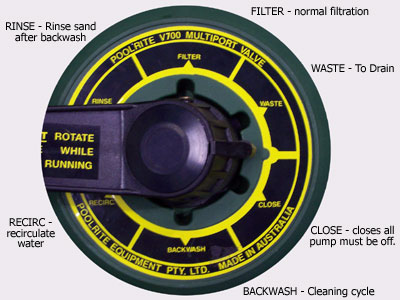
Backwashing should be done whenever the pressure increases on the filter gauge, when the water flow decreases or cleaner stops working, or every 2-3 months. To backwash your filter simply turn the multiport valve handle (the handle on top or beside the filter with a number of options such as Filter/Rinse/Waste etc). Make sure the pump is off (never turn the valve with the pump on). Turn this handle to the backwash position . Then switch on the pump. This will wash water through the filter washing any dirt down the drain. You should be able to see this water through either a sight glass on the valve or through a clear section of pipe, otherwise watch the water pouring into the drain. When the water starts to clear, switch off the pump and turn the handle to rinse. Run the pump on rinse for approximately one minute to rinse any disturbed dirt from the filter so it does not go back into the pool. Some older filters may not have a rinse function. Backwash these until the water is clear to avoid sediment returning to the pool. Return the valve to the filter position when finished and your pool can be used as normal. Diatomaceous earth filters need to be thoroughly disassembled and cleaned every 6-12 months. If you find the pressure increases rapidly again after backwashing you may need to disassemble the filter. If you have persistent high pressure problems with a sand filter contact a pool shop for assistance.
Properly treated pool water is often better than our tap water. Water conscious pool owners may want to use this water to water lawns and gardens. This should not affect any lawns or native plants. The pH of your pool water is 7.2-7.8 so it may not be ideal for rose gardens or other gardens treated to meet certain pH soil recommendations (through the use of Lime or similiar).
Due to the dry drought conditions facing Sydney and NSW at this time we are finding pools are accumulating a lot more loose sediment and dust than normal, especially during periods of high wind. If you have an automatic cleaner you may have to backwash even more often due to these conditions. Your pool may look spotless compared to your neighbour but that will be because all the extra sediment has been collected by your cleaner and sucked up into your filter so your filter will need to be cleaned more regularly.

The following diagrams show the most common types of multiport valves.

Hayward MPV Quiptron 2000 MPV

Salt Chlorinators

Salt is actually Sodium Chloride. Salt Chlorinators work by breaking up the salt molecules and releasing the chlorine into the water. This is how they chlorinate your pool for you.

By keeping a level of salt between 0.4% and 0.7% (depending on brand) they can produce 15 – 30 grams of chlorine per hour. As a side effect the chlorinator cell will clog up with a calcium residue which needs to be cleaned regularly (fortnightly to monthly). Due to the way salt chlorinators work they also increase the pH of the pool by creating Sodium Hydroxide (a base). The means that you will need to add acid to the pool more frequently to compensate.

The best way to test your salt level is to take a sample to your local pool shop, however test strips are now available.

Cells should be cleaned vary carefully. If cleaned regularly while any calcium deposits are soft they can be simply washed under a tap. Warm water can help. If the deposits are harder you may need to soak the cell in either a 10/1 or weaker water/acid solution or a cell cleaner (an organic acid). This will help soften the deposits. Do not leave the cell in this solution for longer than necessary as this will shorten the life of your cell. A paddlepop stick or similiar wooden or plastic instrument can be carefully used to remove calcium deposits. Do not brush or scrub the cell. Chlorinator cells are plated in Titanium and Platinum, hence the cost, like Jewellery. This plating is what makes your cell produce adequate amounts of chlorine. If it wears too much the cell will go black in color and will not produce enough chlorine. You must treat your cell like jewellery when cleaning to ensure it lasts.

Self cleaning chlorinators are available but check the life expectancy of the cell and it’s replacement cost as many are worth almost double the cost of a normal cell and do not last as long due to their self cleaning process. Self cleaning chlorinators save you from maintenance of your chlorinator at a small premium. Some cells like the Watermaid Ezy-Clean are so simple to clean that a self cleaning unit is unnecessary. The new Watermaid power supply is self-cleaning as standard and it’s patented design will not reduce the life expectancy of the cell.

Make sure you have a stabiliser (isocyanuric acid) level of 50-100 in your pool. Due to the slow production rate of chlorinators on a hot day the sun can remove chlorine faster than your cell can make it. Stabiliser holds the chlorine in the water.

Some plumbing is required to install a new salt chlorinator and it might be worth letting the professionals install it correctly. Otherwise ask us for advice and we can show you how. It is essential that self cleaning chlorinators are plumbed correctly. Incorrect plumbing can impact on the self cleaning effect.

Salt chlorinators save you having to dose the pool with chlorine daily however they do still require regular maintenance. They are not cheaper than just using chlorine but they can look after your pool when life is busy.